

6 Ways to Create Real Estate Signs for Your Business
January 7, 2022
A-frame signs, also called sandwich boards, are commonly used to display promotions, directions, announcements, and other messages near storefronts, entrances, sidewalks, and event spaces. Choosing the right size depends on how much space is available, how far away the sign needs to be read, and how much information the graphic needs to display.
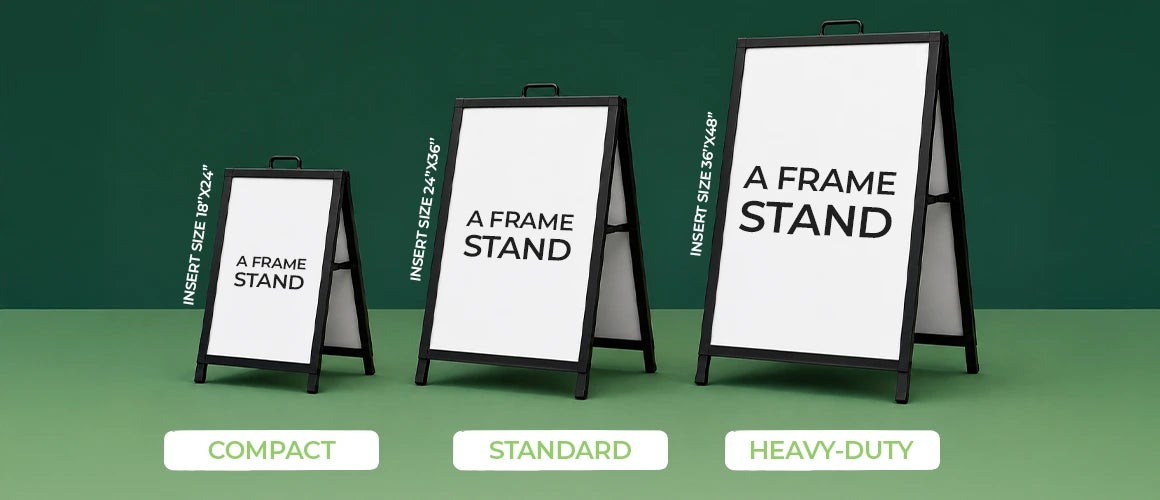
Common A-frame graphic sizes include 18″ × 24″, 22″ × 28″, and 24″ × 36″. Larger formats, such as 32″ × 48″ and 36″ × 48″, can also be used when a larger display area is appropriate.
One important detail is that the advertised A-frame size usually refers to the graphic or insert dimensions, not necessarily the complete standing frame. The assembled frame may be wider, taller, or deeper depending on its construction and opening angle.
| A-Frame Graphic Size | Best For | Key Advantage |
| 18″ × 24″ | Store entrances, cafés, short messages, directional signs | Compact and easy to position |
| 22″ × 28″ | Retail promotions, café specials, storefront offers | Balanced graphic area and footprint |
| 24″ × 36″ | Storefronts, restaurants, sidewalk advertising | Larger graphic area for prominent messaging |
| 20″ × 30″ | Applications requiring a different proportion | Useful for specific display requirements |
| 32″ × 48″ | Large properties, events, spacious outdoor areas | Provides substantially more display space |
| 36″ × 48″ | Large outdoor areas and high-visibility applications | Accommodates larger graphics and messages |
These dimensions describe common graphic or insert formats, not universal overall A-frame dimensions. The complete frame size can vary depending on the frame design.
Before selecting an A-frame sign, it is important to understand that graphic dimensions and overall frame dimensions are different measurements.
An A-frame can have several relevant measurements:
For example, a frame designed to hold a 24″ × 36″ graphic will not necessarily measure exactly 24″ × 36″ when assembled.
Two A-frame signs that hold the same graphic size can also have different overall footprints because their bases, support structures, frame construction, and opening angles may differ.
When planning a display, consider the graphic size, visible area, overall frame dimensions, and open footprint separately.
An 18″ × 24″ A-frame is a compact option for locations where space is limited or where the message will be viewed from a relatively short distance.
This size can work well for:
The smaller panel makes this format relatively easy to position, move, and store.
Choose 18″ × 24″ when conserving space is more important than maximizing graphic area.
The 22″ × 28″ format provides a middle-ground option between the compact 18″ × 24″ size and the larger 24″ × 36″ format.
It can be suitable for:
This size is useful when a design needs more graphic area than an 18″ × 24″ panel provides without requiring the larger dimensions of a 24″ × 36″ display.
24″ × 36″ is a common A-frame graphic size and a popular choice for storefront and sidewalk advertising.
The larger panel provides more room for:
It can work well for:
If you need a larger graphic area for a storefront or sidewalk message, 24″ × 36″ is a practical starting point.
However, it should not be treated as a universal A-frame dimension. The actual frame size and footprint depend on the design of the sign.
Larger formats, including 32″ × 48″ and 36″ × 48″, provide substantially more graphic area than the smaller formats.
They may be appropriate for:
Larger A-frames can also function as outdoor displays when additional graphic space is needed in a spacious environment.
Before selecting a larger A-frame, consider the complete open footprint, the available placement area, viewing conditions, and any applicable local requirements.
For a typical sidewalk application, a large board can create unnecessary placement problems if the location does not have enough room.
The right A-frame size depends primarily on available space, viewing conditions, message length, and portability.
If you are unsure which size to choose, measure the available placement area first. Then compare that measurement with the A-frame’s complete overall dimensions rather than relying only on the graphic size.
There is no single sidewalk-space requirement that applies to every A-frame sign or every U.S. location.
The space required depends on the sign’s actual open footprint and the rules that apply to the specific location. Local requirements may address sign dimensions, placement, permits, operating hours, the number of signs permitted, and pedestrian clearance.
When planning an outdoor A-frame:
For accessible routes covered by the 2010 ADA Standards, accessible walking surfaces generally require a 36-inch minimum clear width, subject to the applicable exceptions and conditions in those standards.
This should not be interpreted as a universal 36-inch placement rule for every A-frame sign. Local requirements can be more specific.
Always verify the regulations that apply to the particular sidewalk or property before placing an A-frame sign outdoors.
The distinction between graphic size and overall frame size is especially important when creating artwork, ordering replacement graphics, or planning where an A-frame will stand.
A 24″ × 36″ graphic does not necessarily mean the assembled A-frame is exactly 24″ × 36″.
The final dimensions can be affected by:
This distinction matters when:
Do not design or order based solely on the advertised graphic size. Confirm the exact insert dimensions, visible area, and overall frame measurements for the specific A-frame design.
Choosing the right size is only part of creating an effective sidewalk sign. The available graphic area should be used strategically so that the message can be understood quickly.
Prioritize one main message instead of filling the sign with lengthy copy. A concise headline is generally easier to scan from a sidewalk.
Make sure the text stands out clearly from the background, particularly when the sign will be viewed outdoors or from a distance.
Use simple, legible fonts and give the primary message enough size and spacing to be read comfortably.
Avoid filling every part of the panel. Adequate spacing can make headlines, prices, logos, and promotional offers easier to scan.
A clear call to action can tell viewers what to do next.
Examples include:
The goal is to communicate the most important information quickly without overcrowding the available graphic area.
A-frame construction can affect durability, weight, appearance, portability, and outdoor suitability. The appropriate material depends on the specific design and intended environment.
Plastic A-frame signs are commonly used in portable sidewalk-display designs. Depending on the construction, features may include ballast compartments, handles, and replaceable graphics.
For outdoor use, consider the sign’s weight, ballast requirements, weather exposure, and recommended operating conditions.
Metal A-frame signs can provide a more substantial structure and are used in designs that accommodate posters, interchangeable graphics, or rigid panels.
They can be suitable for storefronts, restaurants, retail locations, and other environments where a structured display is preferred.
Wood and chalkboard-style A-frames are often used by cafés, restaurants, bakeries, and other businesses seeking a traditional appearance.
Their suitability for outdoor use depends on the specific construction, finish, weather exposure, and care requirements.
There is no single universal A-frame sign size for every sidewalk, storefront, or outdoor application.
Common graphic formats include 18″ × 24″, 22″ × 28″, and 24″ × 36″, with larger sizes such as 32″ × 48″ and 36″ × 48″ used when additional display area is appropriate.
The best size depends on your available placement area, viewing conditions, message requirements, and portability.
Most importantly, distinguish between the graphic size and the overall frame dimensions. A graphic measuring 24″ × 36″ does not necessarily mean the assembled A-frame has the same dimensions.
Before placing an A-frame outdoors, measure the available space, consider the sign’s complete open footprint, confirm the appropriate graphic dimensions, and verify any local sidewalk-placement requirements.
What are the standard A-frame sign dimensions?
There is no single universal A-frame sign dimension in the U.S. Common graphic sizes include 18″ × 24″, 22″ × 28″, and 24″ × 36″, while larger formats such as 32″ × 48″ and 36″ × 48″ can be used for applications requiring more display area.
The overall frame dimensions vary according to the frame design.
What is the most common A-frame sign size?
24″ × 36″ is a common A-frame graphic size and is frequently used for storefront and sidewalk advertising. Smaller formats such as 18″ × 24″ and 22″ × 28″ can be more appropriate where space is limited.
Is 24″ × 36″ a standard A-frame sign size?
24″ × 36″ is a commonly used A-frame graphic size, but it is not a universal U.S. requirement or the only standard option. A-frame dimensions vary according to the design and intended application.
What are the most common sandwich board sizes?
Common sandwich board or A-frame graphic sizes include 18″ × 24″, 22″ × 28″, and 24″ × 36″. Larger formats can also be used when additional graphic area is needed.
What is the difference between A-frame graphic size and frame size?
The graphic size refers to the printed panel or insert designed to fit the frame. The overall frame size includes the complete supporting structure.
Therefore, a 24″ × 36″ graphic does not necessarily mean the assembled A-frame is exactly 24″ × 36″.
How much sidewalk clearance does an A-frame sign need?
The required clearance depends on the site’s accessibility requirements and local regulations.
Measure the sign’s complete open footprint and make sure the required accessible pedestrian route remains unobstructed. The 2010 ADA Standards generally specify a 36-inch minimum clear width for accessible walking surfaces, subject to applicable exceptions and conditions.
What size A-frame sign is best for a storefront?
24″ × 36″ is a practical choice for many storefront applications because it provides a larger graphic area while remaining manageable for typical sidewalk messaging.
If placement space is limited, an 18″ × 24″ or 22″ × 28″ format may be more appropriate.
What size A-frame sign is best for a small sidewalk?
An 18″ × 24″ or 22″ × 28″ A-frame can be a practical starting point when placement space is limited.
Always compare the sign’s actual open footprint with the available space before choosing a size.
Can A-frame signs be custom sized?
Custom graphic or panel dimensions may be possible for some A-frame designs. The graphic dimensions need to match the specific frame’s insert area and retention system.
Think about the last yard sign you actually noticed. Chances are that you did not stop reading a paragraph of…
If you have ever seen a graphic rise from a slim floor base at a trade show, store or reception…
Choosing the right window decals for your store or office depends on your primary goal, whether that means boosting storefront…
Outdoor vinyl stickers are an excellent choice for durability and aesthetics, but many users face the challenge of maintaining their…
Yard signs are a cost-effective and versatile way to get your message across whether you're promoting a local event, supporting…
Have you ever printed a banner, poster, or sign and found that the image looked blurry or pixelated? This happens…