No Trespassing Signs Laws – What a Sign Can and Can’t Do In All 50 States
September 8, 2026
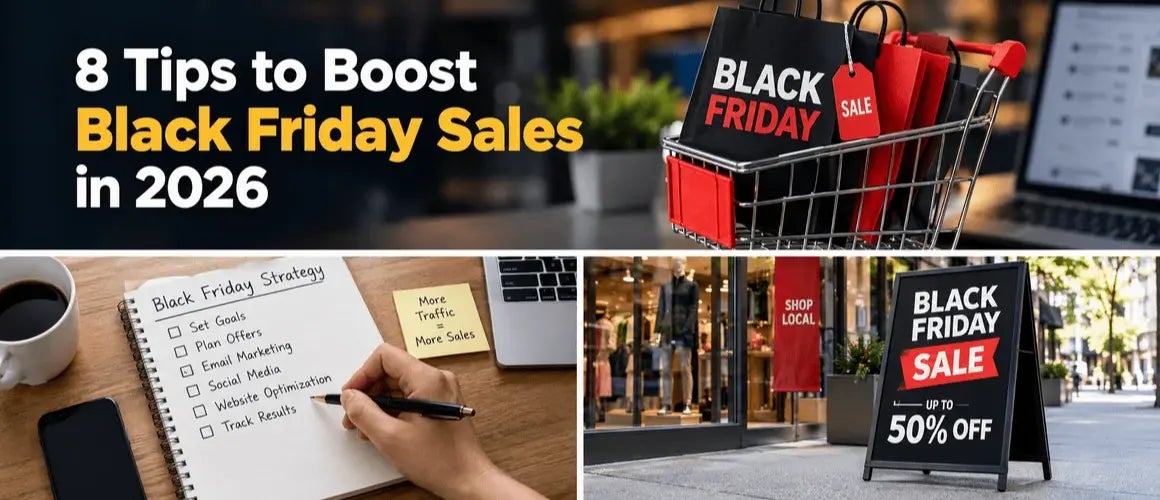
Black Friday is a major opportunity for businesses to attract new customers, increase revenue, and prepare for the holiday shopping season. In 2026, Black Friday falls on November 27, followed by Cyber Monday on November 30.
But offering discounts alone does not guarantee more sales. Businesses need a compelling offer, effective marketing, a convenient shopping experience, and a plan to measure results.
Whether you run an e-commerce store, a local retail shop, or a small business, the right Black Friday marketing strategies can help you reach potential customers and turn interest into purchases.
Here are eight practical ways to boost Black Friday sales in 2026, from early promotions and email marketing to storefront advertising and post-sale follow-up.
Before launching Black Friday ads or announcing discounts, decide what you want your campaign to achieve. A business looking to attract new customers needs a different strategy from one focused on increasing average order value or encouraging repeat purchases.
Start by reviewing previous sales, popular products, customer behavior, inventory, and profit margins. Use these insights to choose a realistic target and build your campaign around it.
For example, an online retailer might promote complementary products to increase order value, while a local shop might focus on attracting nearby customers through storefront promotions. A business with an established customer base could offer early access to encourage repeat purchases.
How to put this strategy into action:
A clear goal helps you prioritize the Black Friday promotion ideas most relevant to your business. It also prevents you from judging success by revenue alone when campaign costs may reduce profitability.
Waiting until Black Friday to announce a promotion can leave your business competing for attention when shoppers are already seeing offers from multiple retailers. Early promotion gives potential customers more time to discover your offer and gives your business additional opportunities to communicate with interested buyers.
You do not need to reveal every deal at once. Start by announcing the upcoming sale, then share selected products, incentives, or offer details as the date approaches.
For physical retailers, promotional materials can help make an upcoming sale visible to people passing the store. For example, custom banners can display a concise sale announcement, featured offer, or brand message at a suitable storefront or retail location.
Consider giving existing customers or email subscribers early access to selected promotions. This can reward customer loyalty and encourage repeat purchases before the main sale begins.
How to put this strategy into action:
If you are preparing for Black Friday 2026, prioritize the essentials first: finalize the offer, prepare the landing page, schedule key communications, and confirm inventory before expanding the campaign.
Discounts can attract attention, but offering the biggest price reduction is not always the best way to increase Black Friday sales. A campaign may generate more orders while leaving less profit after discounts, advertising, shipping subsidies, and other costs.
Instead, choose offers that provide customers with clear value while supporting your business goals.
Depending on your products and margins, consider product bundles, tiered discounts, gifts with purchase, free shipping above a qualifying order value, or special pricing on selected products.
For example, a retailer selling complementary products could create a bundle at an attractive combined price. Another business could offer an incentive when customers reach a spending threshold, provided the additional order value justifies the discount.
Black Friday promotion ideas to consider:
Before launching an offer, calculate its likely effect on profit margins and average order value. Make sure advertised savings are accurate and the promotion’s terms are easy to understand.
The goal is not simply to sell more products. It is to generate sales that make financial sense for your business.
Black Friday ads can bring visitors to your website, but those clicks are less valuable if shoppers struggle to find the offer, understand the terms, or complete their purchases.
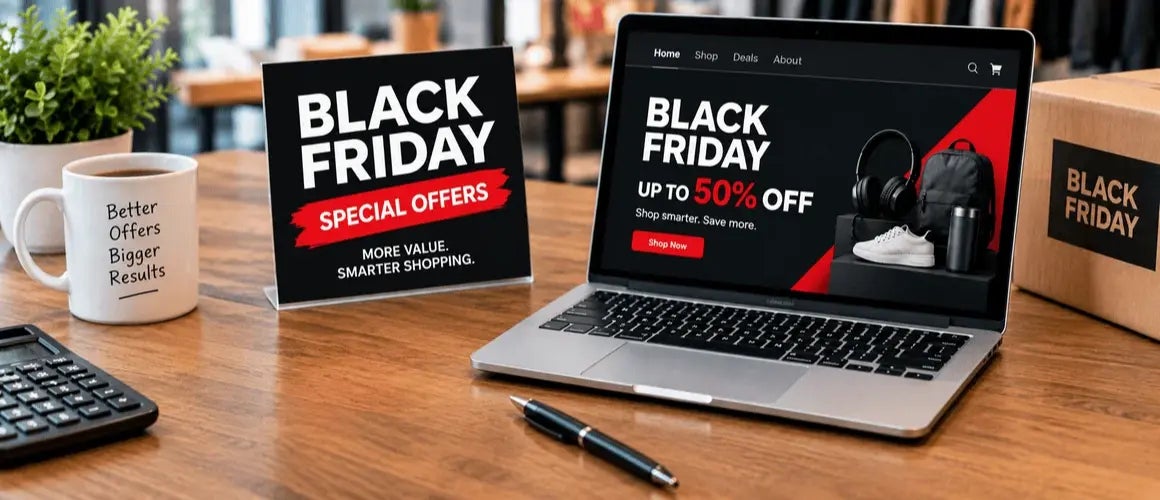
A dedicated Black Friday landing page can bring your campaign together in one place. It should communicate the main offer, showcase relevant products, explain important conditions, and provide a clear path to checkout.
Make sure the landing page matches the message in your advertisements and emails. If an ad promotes a particular discount, visitors should be able to find that offer without searching through unrelated pages.
The mobile shopping experience also deserves attention. Check whether promotional banners display correctly on smaller screens, product information is readable, and checkout fields are easy to use.
Website improvements to prioritize:
If your e-commerce platform supports abandoned-cart reminders, use an appropriate follow-up sequence to reconnect with eligible shoppers who leave without completing an order. Evaluate any additional discount against its cost and the likelihood that the customer would have purchased anyway.
A convenient buying experience helps your business get more value from the traffic its Black Friday marketing generates.
Customers may discover your business through email, social media, paid search, display advertising, or a direct visit to your website. A coordinated campaign helps them recognize your offer and understand what to do next.
Give each channel a clear role rather than publishing the same message everywhere without a plan.
Email can communicate detailed offer information to subscribers. Social media can build awareness and demonstrate products. Paid search can reach people actively looking for relevant products or services, while retargeting can reconnect with eligible visitors who previously showed interest.
Your website should serve as the central destination for the promotion, with consistent pricing, terms, and product information.
Businesses promoting offers at retail locations or promotional events can also use retractable banner stands to present key messages near featured products or other relevant display areas.
How to coordinate your campaign:
Not every business needs to use every channel. A small business with an engaged email list may benefit more from improving its email campaign than from spreading a limited budget across several advertising platforms.
Monitor results as the campaign runs. If a channel attracts clicks but few purchases, review the audience, offer, landing page, and conversion path before increasing spending.
Black Friday shoppers have many offers to compare. Genuine reviews, useful product information, and credible customer experiences can help potential buyers evaluate your business and make more confident purchasing decisions.
For online stores, display relevant customer reviews close to product descriptions and purchasing options. For physical businesses, selected testimonials can be incorporated into promotional displays where appropriate.
Referral programs can complement this approach by encouraging satisfied customers to introduce your business to new buyers.
Practical ways to use social proof:
For example, a local retailer could highlight a relevant customer testimonial in a storefront display while sharing the same product benefit in an email campaign. An online store could feature verified reviews alongside a Black Friday product bundle.
Never fabricate reviews or exaggerate customer experiences. Trust depends on accurate information and a consistent customer experience.
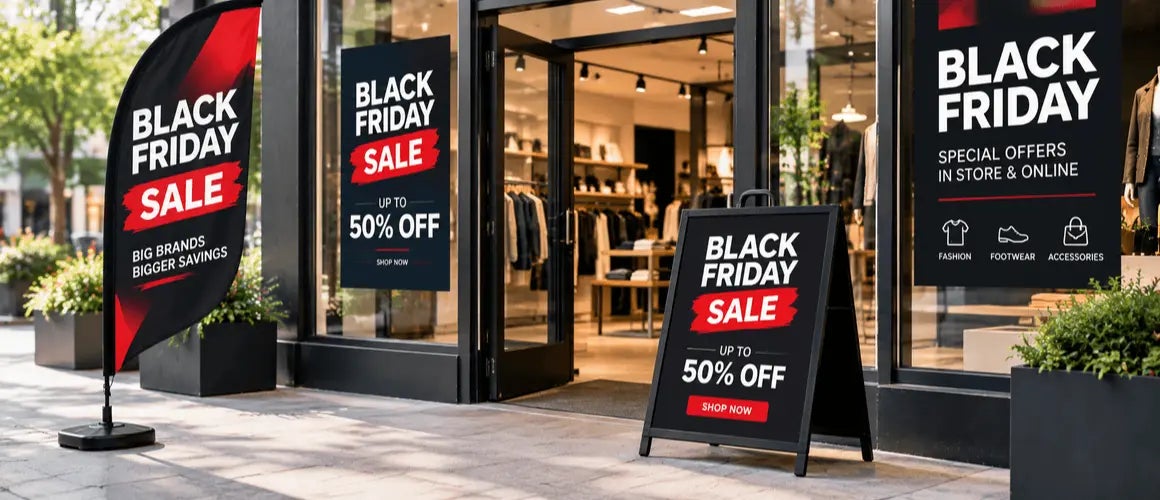
For businesses with physical locations, Black Friday marketing extends beyond digital channels. Storefront signage and well-organized displays can help nearby shoppers notice a promotion, identify featured products, and understand where to go next.
Start with one primary message. A large, readable offer is generally more useful than a display crowded with several competing messages. Make sure shoppers can quickly understand the discount, featured product, or reason to visit.
Different signage formats serve different purposes. A storefront banner can communicate a sale from a distance, while an indoor display can highlight a product offer or direct customers toward a featured category. Window graphics can reinforce promotional messaging where suitable.
How to improve your in-store Black Friday promotion:
For sidewalk promotions, metal A-frame signs can display offers near a storefront entrance, subject to local placement rules. Businesses can also use custom signs and custom decals to reinforce promotional messages on suitable windows, walls, and other surfaces.
For additional outdoor visibility, custom flags can help draw attention to a storefront or business entrance.
For example, a neighborhood retailer could use a storefront banner to announce its main Black Friday offer, an A-frame sign to highlight a featured deal, and an email campaign to share the full details. Each channel supports the same promotion while serving a different purpose.
Signage alone cannot guarantee additional foot traffic or sales. Its effectiveness depends on visibility, placement, the appeal of the offer, and how easily customers can act on the message.
Your Black Friday campaign should not end when the sale closes. Reviewing performance helps you understand which offers, channels, and customer segments generated value, and which need improvement.
Compare results with a relevant baseline, such as a previous campaign or an appropriate period before the sale. Account for differences in promotion length, inventory, pricing, and traffic sources when interpreting the results.
Track metrics that relate directly to your campaign objectives.
| Campaign goal | Metrics to monitor |
| Increase sales | Revenue, orders, conversion rate |
| Improve profitability | Profit, contribution margin, promotional costs |
| Increase order value | Average order value, items per order |
| Acquire customers | New customers, customer acquisition cost |
| Improve email performance | Clicks, conversions, revenue per campaign |
| Evaluate paid advertising | Cost per acquisition, return on ad spend |
| Increase local sales | Store transactions, coupon redemptions, tracked visits where available |
Use the data to identify what worked. A channel with a high click-through rate may still underperform if it does not generate purchases. Similarly, higher revenue does not necessarily mean a campaign was more profitable.
After Black Friday and Cyber Monday, send appropriate order confirmations, customer service updates, and post-purchase communications. Where relevant, invite customers to provide honest feedback and use those insights to improve future campaigns.
Follow-up promotions should be relevant to customer interests and purchasing history, with appropriate consent and communication preferences respected.
The long-term value of a Black Friday campaign includes not only sales generated during the event but also the customer relationships your business can maintain afterward.
Black Friday falls on November 27, 2026. Businesses should prioritize preparation based on their team, inventory, budget, and sales channels.
| Timing | Priority actions |
| October 26-November 1 | Set campaign goals, review inventory and margins, finalize the offer, and plan the landing page. |
| November 2-8 | Prepare creative assets, configure tracking, test the website, and schedule email and social content. |
| November 9-15 | Announce the upcoming sale, build awareness, and begin relevant audience-building activities. |
| November 16-23 | Share offer details, activate suitable paid campaigns, and verify inventory, shipping, and checkout. |
| November 24-26 | Send relevant reminders or early-access offers and complete final campaign checks. |
| November 27-30 | Monitor Black Friday through Cyber Monday performance, inventory, customer questions, and campaign spending. |
| December 1 onward | Review results, fulfill orders, follow up with customers, and document lessons for next year. |
If you are starting later, focus first on the essentials: a viable offer, accurate landing page, available inventory, functioning checkout, and a manageable promotional plan. Do not sacrifice accuracy or site testing to launch additional channels.
Boosting Black Friday sales takes more than publishing a discount or increasing advertising spend. Businesses need an offer that makes financial sense, a clear promotional plan, a convenient buying experience, and consistent communication across the channels their customers use.
For Black Friday 2026, prioritize the activities that best fit your business: prepare your offer, make it easy to purchase, reach relevant customers, and measure the results. If you operate a physical store, combine digital marketing with clear storefront signage to support the same campaign.
Most importantly, evaluate success by the value the campaign creates, not just the number of orders. A well-planned Black Friday promotion can help you generate sales, learn more about your customers, and build a stronger foundation for the holiday shopping season.
Black Friday 2026 is Friday, November 27. Cyber Monday follows on Monday, November 30. Businesses can plan promotions before these dates, but should communicate the actual start and end times of their offers clearly.
A small business can focus on a clear offer, early customer communication, email marketing, relevant social media content, customer referrals, and a convenient buying experience. Businesses with physical locations can also use storefront signage to communicate promotions to nearby shoppers.
The most suitable strategies depend on your audience and objectives. Common options include early-access offers, segmented email campaigns, product bundles, dedicated landing pages, retargeting, customer reviews, and storefront promotions. Measure performance to determine which tactics work for your business.
Early sales give customers more time to discover your offer and help distribute promotional activity across a longer period. They may also help businesses engage existing customers before the main shopping weekend. However, early discounts can reduce margins or shift purchases that would have happened later, so evaluate their incremental value.
Businesses can use storefront banners, window messaging, promotional displays, and directional signs to communicate offers and help shoppers navigate the store. Keep the message concise, make terms readable, and ensure that signage reflects the actual promotion.
Track metrics that match your goals, including revenue, conversion rate, average order value, profit, customer acquisition cost, and channel-level performance. Compare results with an appropriate baseline and account for promotional costs before deciding whether a campaign succeeded.
Selecting proper visual displays for outdoor events, retail storefronts, or trade shows can make or break your foot traffic. Outdoor…
Setting up an outdoor display or vendor booth usually feels like a job meant for two or three people. When…
Think about the last yard sign you actually noticed. Chances are that you did not stop reading a paragraph of…
If you have ever seen a graphic rise from a slim floor base at a trade show, store or reception…
Choosing the right window decals for your store or office depends on your primary goal, whether that means boosting storefront…
Outdoor vinyl stickers are an excellent choice for durability and aesthetics, but many users face the challenge of maintaining their…