Custom Banner Guide: How Long Does a Banner Last?
February 28, 2023
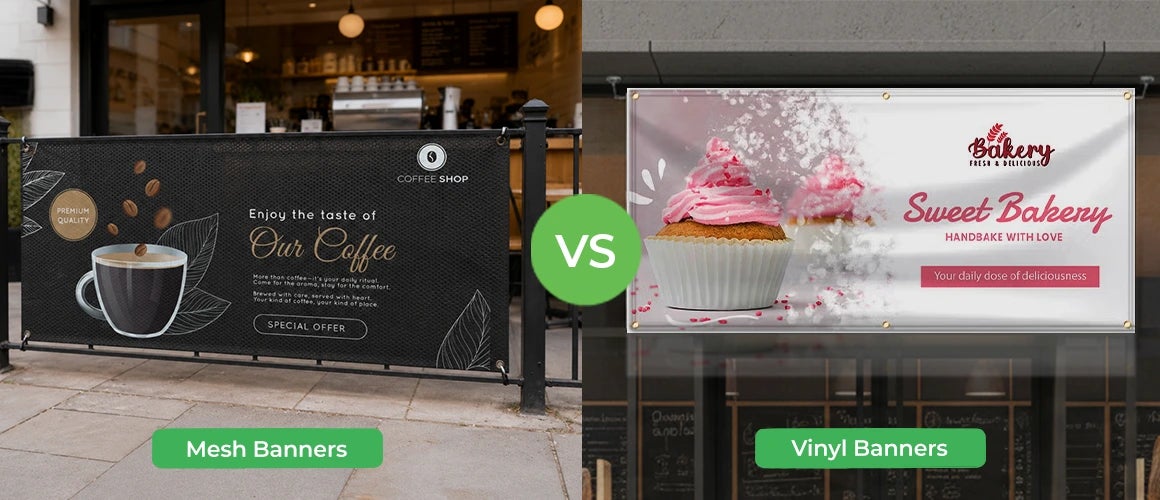
Mesh and vinyl banners are both popular choices for outdoor signage, but they are designed for different installation needs. A vinyl banner has a solid, opaque surface that provides strong color density, sharp graphics, and a clean visual appearance. A mesh banner has a perforated construction that allows air to pass through, making it particularly useful for exposed locations where wind is an important consideration.
So, which is better: mesh or vinyl? There is no universal winner. Choose vinyl when maximum visual impact, opacity, and detailed graphics are your priorities. Choose mesh when airflow and reduced wind resistance are more important, especially for fences, construction sites, scaffolding, and other exposed outdoor installations.
The right choice also depends on banner size, viewing distance, mounting method, weather exposure, and the design you plan to print.
| Feature | Vinyl Banners | Mesh Banners |
| Construction | Solid PVC Flex | Perforated PVC mesh |
| Surface | Solid and opaque | Open/perforated |
| Airflow | Limited through the banner | Air passes through perforations |
| Wind performance | Better suited to sheltered or solid-backed locations | Better suited to exposed, windy locations |
| Print appearance | Strong color density and sharp detail | Clear graphics with a more open appearance |
| Weight | Generally heavier than mesh | Generally lighter than solid vinyl |
| Best applications | Walls, storefronts, events, promotions | Fences, construction sites, scaffolding, exposed outdoor areas |
| Main advantage | Visual impact and opacity | Airflow and reduced wind resistance |
Bottom line: If you are installing a banner against a solid wall and want bold, detailed graphics, vinyl is usually the better choice. If you are installing a banner on an exposed fence or another location where wind is a concern, mesh is usually the better choice.
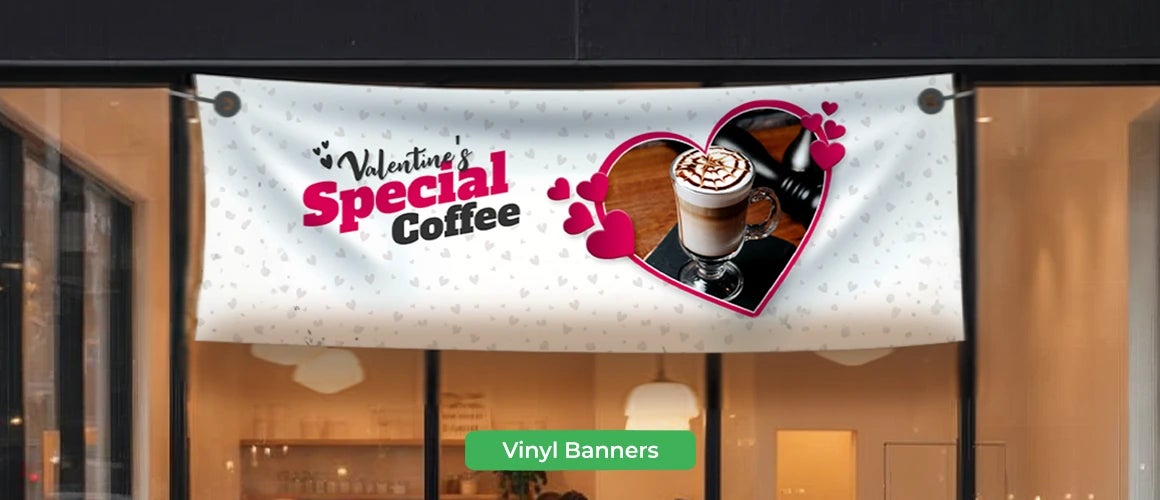
A vinyl banner is a solid banner made from PVC Flex material. Unlike mesh, it does not have perforations across the printed surface, giving it a continuous and opaque appearance.
That solid surface is particularly useful for designs where you want strong color impact, readable text, logos, photographs, and detailed graphics.
Vinyl banners can be used for indoor and outdoor signage, depending on the specific product and installation. Common applications include storefront promotions, grand openings, events, trade shows, walls, sports events, and other promotional displays.
Best of Signs currently offers 13 oz standard and 16 oz premium vinyl banner options.
If maximum visual impact is your priority, choose custom vinyl banners.
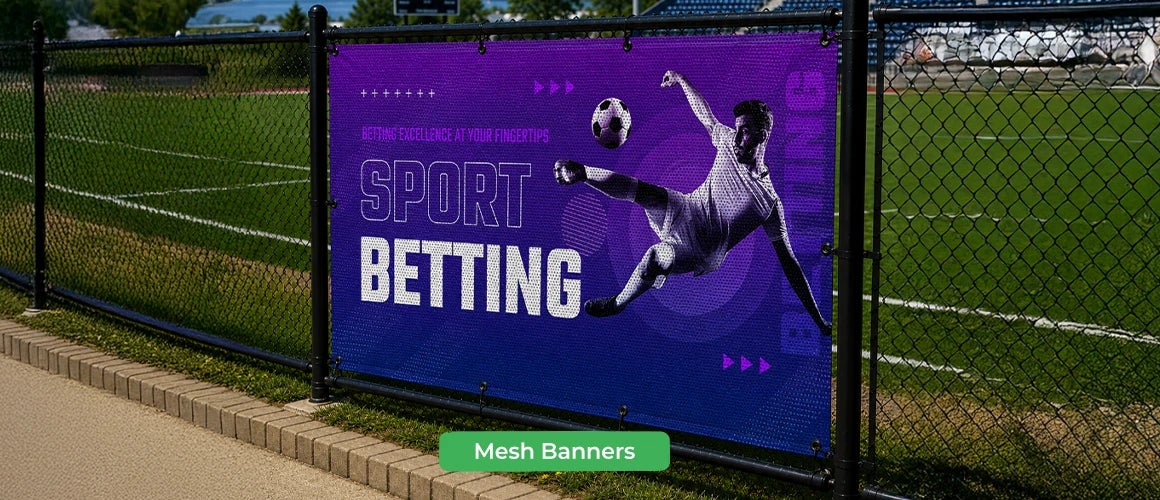
A mesh banner is a perforated PVC banner designed to allow air to pass through the material.
Instead of presenting one continuous solid surface to moving air, the open construction allows airflow through the banner. This makes mesh particularly useful for outdoor applications where wind exposure is an important consideration.
Typical applications include chain-link fences, construction fencing, scaffolding, sports facilities, outdoor events, and other exposed locations.
Best of Signs currently lists its mesh banners as 8 oz PVC mesh with 720 DPI eco-solvent printing.
For outdoor installations where airflow matters, choose custom mesh banners.
The fundamental difference is simple:
Vinyl has a solid surface. Mesh has a perforated surface.
That construction difference affects airflow, wind performance, appearance, weight, and the applications for which each material is most appropriate.
Wind is one of the biggest factors to consider when choosing between mesh and vinyl.
A solid vinyl banner presents a continuous surface to moving air. When installed in an exposed location, wind can place stress on the banner, fasteners, and supporting structure.
A mesh banner allows air to pass through its perforations, which can reduce the amount of solid surface presented to moving air. Best of Signs specifically describes its mesh construction as allowing airflow to reduce wind resistance during windy conditions.
For this reason, mesh is generally better suited to applications such as:
However, mesh is not windproof.
Actual performance depends on banner size, wind conditions, attachment method, spacing of mounting points, supporting structure, and installation location. Severe weather can damage banners and mounting systems regardless of material.
Best choice for exposed, windy locations: Mesh
If your primary concern is the appearance of the printed design, vinyl generally has the advantage.
Because vinyl has a solid surface, it provides a continuous area for printing. This can produce a stronger, denser visual appearance, particularly for detailed designs.
Vinyl is a strong choice for:
Mesh can still display graphics effectively, particularly when the banner is viewed from a normal distance. However, the perforations mean that the printed surface does not have exactly the same solid appearance as vinyl.
Best choice for maximum visual density and detail: Vinyl
Airflow is the defining functional advantage of mesh.
The perforations allow air to move through the banner rather than pushing against a completely solid surface.
Vinyl has a continuous surface, so it provides substantially less airflow through the material itself.
This difference becomes particularly important for large banners installed in exposed areas.
Best choice when airflow is a major requirement: Mesh
Mesh is generally lighter than solid vinyl.
That can make a difference when a large banner needs to be transported, positioned, or installed manually.
Large outdoor installations can involve significant amounts of material, so weight should be considered alongside:
However, lighter does not automatically mean more durable. Material construction and installation conditions both affect performance.
Best choice when lower material weight is helpful: Mesh
Both mesh and vinyl can be used for outdoor signage, but durability is not determined by material alone.
Outdoor banner performance can be affected by:
Mesh has an important advantage when the installation environment creates significant wind exposure because its open construction allows airflow.
Vinyl has an important advantage when you want a solid, opaque surface with strong printed graphics.
Therefore, it is more accurate to ask:
Which material is better suited to my installation?
rather than:
Which material is universally more durable?
Best choice: It depends on the installation environment.
Both mesh and vinyl are used for outdoor signage and can be exposed to rain and moisture.
Best of Signs describes its vinyl banners as tear- and water-resistant and its PVC mesh banners as tear- and water-resistant for outdoor use.
However, weather resistance should not be confused with unlimited weather durability.
A banner’s outdoor performance depends on its material, printing, installation, mounting system, exposure, and maintenance.
If the location experiences significant wind, the material choice becomes especially important because wind can affect the banner and its mounting points.
Best choice: Both can work outdoors; choose based on the complete installation environment.
The material is only one part of a successful banner installation.
Both vinyl and mesh banners can be configured with finishing options such as grommets or pole pockets, depending on the product and intended installation. Best of Signs lists brass grommets and pole pockets for its mesh banners and brass grommets, pole pockets, and adhesive tabs for its vinyl banners.
For exposed installations, pay particular attention to:
A correctly selected material can still perform poorly if it is poorly mounted.
Best choice: The material and mounting method should be selected together.
The easiest way to choose between the two materials is to start with where the banner will be installed.
Mesh is often a strong choice for chain-link fence applications because the perforated material allows air to pass through.
Common uses include:
If your primary requirement is a banner for fencing, choose fence banners.
A fence installation can expose a banner to wind from multiple directions. A solid banner presents a continuous surface, while mesh provides openings through which air can pass.
The actual performance still depends on the fence, banner dimensions, attachment method, wind conditions, and supporting structure.
Construction sites frequently use chain-link fencing and temporary perimeter structures.
Mesh can be useful for:
The ability to allow airflow is particularly relevant when a large banner is installed along an exposed construction fence.
Mesh can also be useful around sports facilities where banners are mounted along:
These installations may be exposed to wind while also requiring large-format branding that can be seen from a distance.
Vinyl is often the stronger choice for storefront applications when visual impact is the priority.
Its solid surface works well for:
Choosing the right vinyl banner size can help ensure the banner fits the available storefront or wall space. When a banner is mounted against a solid wall, the need for airflow through the banner may be much less important than print appearance.
Vinyl banners are versatile for promotional applications where you want strong graphics and an opaque surface.
Potential uses include:
For broader banner options, explore custom banners.
There is no single answer.
The installation environment matters more than banner size alone.
For a large banner mounted against a solid wall, vinyl may be the better choice because the wall provides backing and the solid surface delivers strong visual impact.
For a large banner installed on an exposed fence or structure, mesh may be more appropriate because airflow becomes a major consideration.
As banner size increases, it becomes increasingly important to evaluate:
Large does not automatically mean mesh. Large and exposed to wind is the more important combination.
Yes, but the installation must be evaluated carefully.
Solid vinyl can be used outdoors, but it has a continuous surface that does not provide the same airflow as mesh.
For applicable large-format vinyl banner applications, wind slits can create openings in the material to help reduce wind pressure. Best of Signs currently offers optional wind slits for its vinyl banners.
However, wind slits do not make a solid vinyl banner equivalent to mesh.
If airflow is a major consideration from the beginning, choosing a purpose-built mesh banner may be more appropriate.
In all cases, severe weather should be taken seriously. No banner material should be treated as a guarantee against damage during extreme weather.
Mesh is not automatically better for every outdoor banner.
It is better suited to outdoor applications where wind exposure is a significant consideration.
Vinyl can be the better outdoor option when the banner is installed in a relatively sheltered location or against a solid surface and the priority is strong color density, opacity, and detailed graphics.
A useful rule is:
If your installation is outdoors and exposed to wind, choose mesh banner.
If your installation is outdoors with solid backing and you want maximum visual impact, choose vinyl banner.
The answer depends on what you mean by visibility.
For color density and opacity Vinyl wins.
Its solid surface provides a continuous visual field.
For large outdoor graphics viewed from a distance both can work well.
Mesh is designed to remain visually effective despite its perforated structure.
For close viewing, vinyl generally provides a cleaner, more solid appearance.
Mesh can show its perforations when viewed closely.
Cost should not be judged by material price alone.
The most cost-effective banner is the one that is appropriate for the installation.
For example, choosing a solid vinyl banner for a large, exposed fence installation solely because of its initial material cost may not be the best decision if wind exposure creates additional installation considerations.
Likewise, choosing mesh for a sheltered wall may provide an airflow benefit that you do not need.
When comparing cost, consider:
Choose the material that fits the application rather than simply choosing the lowest initial price.
Use these six questions before placing your order.
1. Where will the banner be installed?
A wall or storefront generally points toward vinyl.
A chain-link fence or exposed outdoor structure generally points toward mesh.
2. How much wind will the banner experience?
Frequent wind exposure makes mesh worth considering because of its airflow.
3. How important is maximum graphic detail?
If sharp text, dense colors, photographs, and opacity are priorities, vinyl is generally the stronger choice.
4. How large is the banner?
Larger banners can experience greater wind forces, making installation and material selection increasingly important.
5. How will the banner be mounted?
Consider grommet placement, attachment spacing, hardware, the supporting structure, and installation height.
6. What happens during severe weather?
Plan for weather rather than assuming any banner is immune to extreme conditions.
| If your priority is… | Recommended material |
| Maximum color density | Vinyl |
| Solid, opaque appearance | Vinyl |
| Detailed graphics | Vinyl |
| Storefront promotions | Vinyl |
| Wall-mounted banners | Vinyl |
| Trade show graphics | Vinyl |
| Airflow | Mesh |
| Exposed chain-link fencing | Mesh |
| Construction fencing | Mesh |
| Scaffolding | Mesh |
| Wind-exposed outdoor installations | Mesh |
| Lightweight large-format handling | Mesh |
This is a guideline, not a guarantee of performance. The correct material also depends on banner dimensions, mounting, supporting structure, weather, and the specific installation.
Vinyl is the better choice when your main goal is maximum visual impact.
Its solid surface provides an opaque appearance, strong color density, and a good surface for detailed graphics.
Mesh is the better choice when your main concern is airflow.
Its perforated construction allows air to pass through the material, making it particularly useful for fences, construction sites, scaffolding, sports facilities, and other exposed outdoor locations.
So the simplest decision is:
Choose vinyl for visual impact and a solid, opaque surface. Choose mesh when airflow and wind exposure are major considerations.
If you are still comparing banner materials, browse custom banners to find an option suited to your application.
Neither is universally better. Mesh is generally better suited to windy, exposed installations because air can pass through its perforations. Vinyl is generally better when you want maximum color density, opacity, and detailed graphics.
The main difference is the surface construction. Vinyl has a solid surface, while mesh has perforations that allow air to pass through. This affects wind performance, appearance, and the applications for which each material is best suited.
Mesh is generally better suited to windy locations because its perforated construction allows airflow. However, mesh is not windproof. Banner size, mounting, supporting structure, wind conditions, and installation all affect performance.
Vinyl generally provides stronger color density and a more solid visual appearance because it has a continuous printing surface. Mesh can still provide clear graphics, especially when viewed from normal outdoor distances.
Best of Signs describes its PVC mesh banners as water-resistant and suitable for outdoor use. Long-term performance still depends on the complete product, printing, installation, weather exposure, and maintenance.
Some light and background visibility can be seen through the perforations, particularly at close range. Mesh is not completely opaque like solid vinyl.
Yes. Mesh is particularly suitable for many chain-link fence applications because its perforated construction allows airflow. Fence construction, banner size, mounting method, and local weather conditions should still be considered.
Yes, but suitability depends on the fence, banner size, wind exposure, and mounting method. For exposed chain-link fencing, mesh is often a more appropriate option because it allows airflow through the banner.
Not completely. Wind slits can provide openings in some solid vinyl banners to help reduce wind pressure, but they do not create the same perforated construction as mesh. If airflow is a primary requirement, mesh is generally the more appropriate choice.
Generally, yes. Mesh is typically lighter than solid vinyl, although the actual weight depends on the specific material and banner dimensions.
Vinyl is generally the better choice for storefronts when strong colors, opacity, and detailed graphics are priorities, particularly when the banner is mounted against a solid surface.
Mesh is often the better choice for construction fences because its perforated structure allows airflow and can reduce wind resistance compared with a solid banner.
Start with the installation environment rather than the banner size alone. If the location is exposed to significant wind, mesh is generally worth considering. If the banner has solid backing and visual impact is the priority, vinyl may be the better choice.
There is no single lifespan that applies to every banner. Outdoor longevity depends on the material, printing, sunlight, weather, wind exposure, mounting method, installation, handling, and maintenance. Avoid relying on a fixed number of years unless it is supported by the specific product’s manufacturer or testing data.
Outdoor vinyl stickers are an excellent choice for durability and aesthetics, but many users face the challenge of maintaining their…
Yard signs are a cost-effective and versatile way to get your message across whether you're promoting a local event, supporting…
Have you ever printed a banner, poster, or sign and found that the image looked blurry or pixelated? This happens…
Choosing the right canopy tent size is about more than finding a tent that fits your event space. You also…
For landowners, the nuisance of potential trespassers and the liability that comes with them is a real concern. Because of…
For landowners, the threat of trespassers and the associated liability is a serious concern. To mitigate this risk, many property…